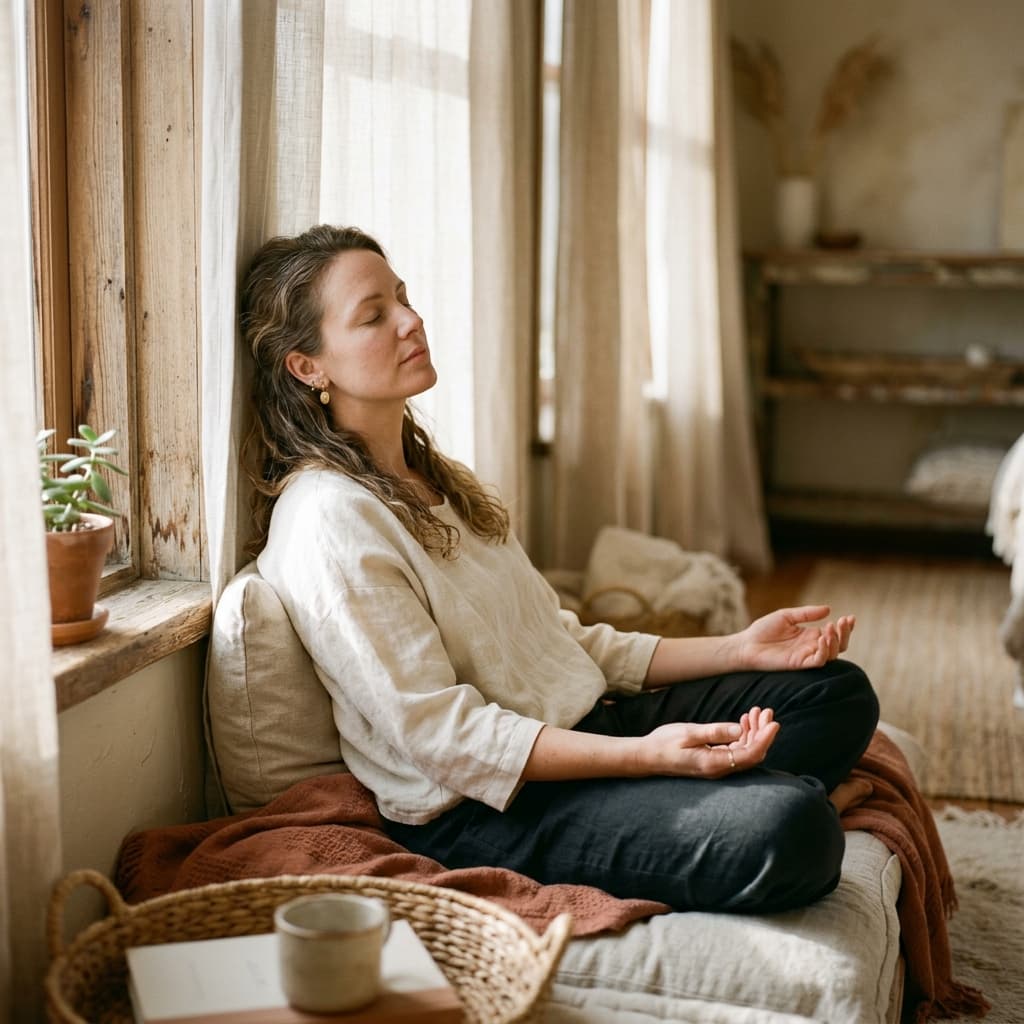
I was sitting on my front step last Saturday with nothing in my hands. No phone, no book, no mug, no purpose. Just my hands on my knees and the concrete step warm from the afternoon sun beneath my thighs. I sat there for approximately four minutes before the discomfort arrived, which is to say, four minutes before my body began to fidget, my mind began to generate tasks, and every cell in my thoroughly modern nervous system began screaming the same message: you should be doing something.
I did not do something. I stayed on the step. And the discomfort of staying, the physical itch of it, the specific restlessness that settled into my hands like electricity with nowhere to go, turned out to be more interesting than anything I would have done if I had obeyed the itch.
The Guilt of Stillness
Nothing has a reputation problem. We praise busyness. We admire full calendars. We describe our weekends in terms of accomplishments: I cleaned the garage, I finished the book, I meal-prepped for the week. When someone asks what you did this weekend and you say nothing, the word lands with a thud. It sounds like failure. It sounds like waste. It sounds like the kind of answer that requires a follow-up excuse: I was exhausted, I was unwell, I needed a break. As though nothing requires justification.
The guilt of doing nothing lives in my sternum. I can feel it there: a mild constriction, a sense of wrongness, as if the body itself has internalized the productivity gospel so thoroughly that stillness registers as a violation. My shoulders climb when I sit without purpose. My breathing shallows. The body performs the physical symptoms of guilt before the mind has finished constructing the thought, which tells me the guilt is somatic, not rational. It was installed in the muscles long before it was articulated in the mind.
What the Brain Does When You Stop
Marcus Raichle, a neurologist at Washington University in St. Louis, discovered something in the early 2000s that should have changed our relationship with doing nothing. He found that the brain does not go quiet when you stop doing things. It switches to a different mode. Raichle called it the default mode network: a set of brain regions that activate specifically when you are not focused on an external task. When you stare out a window, sit on a step, lie on the grass watching clouds, the default mode network lights up like a city grid at dusk.
This network is working. Actively. It consolidates memories. It integrates emotional experiences. It runs simulations of future scenarios, testing possibilities the conscious mind has not yet considered. It makes connections between ideas that the focused, task-oriented brain keeps in separate drawers. The default mode network is, in a very real sense, the brain’s research department. And it only opens for business when you stop giving it assignments.
I find this genuinely funny. We spend our days feeding the brain an unbroken stream of stimulation, tasks, screens, conversations, podcasts, notifications, and then we wonder why we feel uncreative, why the ideas do not come, why the solutions to obvious problems remain stubbornly invisible. The research department is closed. We never give it the nothing it needs to do its work.
The Practice of Not-Doing
I have been practicing nothing for about six months, and I want to be honest about how difficult it is. It feels confrontational, at least at first, rather than relaxing. When you remove the phone, the book, the podcast, the task, you are left with yourself, and yourself turns out to be a more complicated companion than any of those distractions.
In the first few minutes, the body rebels. The hands search for objects. My right hand, specifically, curls into the shape of a phone grip, the thumb poised for scrolling, a muscle memory so deeply installed that it persists even when there is nothing to scroll. My eyes scan the room for something to read: the label on the bottle, the text on the cereal box, anything with words. The mind generates urgent tasks with remarkable creativity: you should check whether you replied to that email, you should water the plant, you should google that thing you were wondering about this morning.
After about five minutes, if I can outlast the rebellion, something shifts. The body settles. The breathing deepens without being instructed to. My gaze softens, moving from the sharp focus of task-mode to the wide, unfocused gaze of rest. I notice things I do not notice when I am doing: the pattern of light on the wall, the weight of my own hands on my knees, the sound of the house settling around me, small clicks and creaks that are always present but always drowned.
This settling is, I think, what the default mode network feels like from the inside. A quieting of the foreground. A deepening of the background. The sense that something is being sorted, filed, connected, just below the threshold of awareness.
Nothing is not the absence of doing. It is the presence of something the busy mind cannot access: the quiet processing that only happens when you stop feeding it tasks.
What Nothing Gives Back
The returns from nothing are indirect and delayed, which is why they are easy to dismiss. I cannot point to a specific idea that arrived during a specific session of sitting on the step. But I can say that the quality of my thinking has changed since I started making room for not-thinking. Ideas arrive at unexpected moments, fully formed, as if they were assembled somewhere I was not looking. Solutions to problems I had been grinding on for days appear while I am standing at the kitchen window watching rain. The creative work I do in the afternoon is measurably better on the days I did nothing in the morning. Measurably is perhaps too strong. Noticeably. I notice it in my body: a fluidity in the hands, a looseness in the shoulders, as if the nothing cleared a channel that the doing had been blocking.
If you want to try nothing, start with five minutes. Sit somewhere without your phone. Do not meditate, do not journal, do not set an intention. Just sit, and feel what happens. Notice the rebellion: the searching hands, the urgent tasks, the guilt in the sternum. Let them arrive without obeying them. If five minutes feels impossible, try two. If two feels impossible, that itself is worth noticing. A body that cannot tolerate two minutes of nothing is a body that has been running for a long time, and it deserves to know what stillness feels like. Not as a reward. Not as a productivity hack. Just as a thing the body is allowed to do, without earning it first.
