
The Body You Are In
We learned to look at our bodies before we learned to live in them. Shifting from observer to inhabitant changes everything.

I write about attention, the nervous system, and what it takes to stay present in a life that keeps pulling you elsewhere. Based in Portland, Oregon.
In the fall of 2019, I was sitting in a gray Subaru in the parking garage on Morrison Street in Portland, Oregon. The engine was off. The radio was off. My coffee had gone cold in the cupholder sometime in the last hour, and I had not noticed. I was staring at the concrete wall in front of me, which was the color of old dishwater, and I was trying to remember why I had come down here in the first place.
I had been working in project management for a tech company for six years. Promoted twice in three years. I was good at my job in the way that earns raises: I anticipated problems before they surfaced, I kept every deadline, I sent follow-up emails within the hour. My calendar was a wall of colored blocks from seven in the morning until six at night, and I wore that density like a merit badge.
That morning, sitting in that garage, I realized I could not name a single thing I had done that week that was not for someone else's timeline.
My hands were shaking. Not dramatically, not the way they shake in movies. A fine tremor, the kind you would not see unless you were holding a piece of paper. I held up my left hand and watched it vibrate against the steering wheel. The leather was cold. The air smelled like concrete dust and exhaust. Rain was tapping on the windshield, and I could hear it more clearly than I had heard anything in months.
I did not quit my job that day. I did not book a retreat or download a meditation app. I did something so small it barely qualifies as a decision. I sat there for five more minutes. I watched the rain collect on the glass and run in crooked lines toward the wipers. I felt the cold of the steering wheel under my palms. I took one breath that went all the way to the bottom of my lungs, where it sat for a moment before I let it go.
It was the first moment in years that belonged entirely to my body.
I want to be honest about what came before that parking garage, because it was not a crisis. That is the part that makes it difficult to explain. I was not falling apart. I was functioning at a level that most people would call successful. I had health insurance and a retirement account and a partner who loved me and a daughter who was learning to swim. From the outside, I was doing well.
From the inside, I was a project I was managing.
I ate lunch at my desk every day, and I could not tell you what I ate. I exercised on a schedule, and I could not tell you how my body felt during any of it. I slept six hours a night and called it efficient. I had a knot between my shoulder blades, right around T4 and T5, that had been there for four years. I blamed my desk chair. I bought a better desk chair. The knot stayed.
That knot was my body filing a complaint I refused to read.
The particular cruelty of living this way is that it is rewarded. Every promotion confirmed the arrangement: you give your hours, your attention, your physical presence to the work, and the work gives you a number that goes up. I was excellent at ignoring my body's signals because the world I worked in treated that skill as professionalism. Nobody gets promoted for saying, "I need to stop and listen to what my shoulders are telling me."
The shaking hands in the parking garage were not the beginning of something. They were the end of a very long sentence my body had been trying to finish.
If I trace the thread back far enough, it starts in a department store fitting room. I was eleven. Fluorescent lights overhead, a three-panel mirror, and my mother on the other side of the curtain asking if the jeans fit. I remember looking at myself from three angles simultaneously and understanding, for the first time, that my body was an object other people would evaluate.
That was the moment the split began: the body I lived inside and the body I presented to the world. For the next twenty-eight years, I managed the second one. I fed it, exercised it, dressed it, and asked very little about what it was actually experiencing. I treated it the way I treated my projects at work: as a system to be optimized, not a voice to be heard.
I grew up in a small town near a river. The river was a brown, unhurried thing that ran along the edge of town, half-hidden by willows and blackberry brambles. I walked beside it most afternoons. It never occurred to me that the river was doing something I had forgotten how to do: moving at its own pace, responding to what was actually happening rather than what was scheduled, carrying what it carried without apology.
Somewhere between that river and the tech company, I lost the ability to feel my own weather.
After the parking garage, I tried the obvious things. I downloaded a meditation app. I lasted nine days. I tried journaling with prompts; they felt like performance reviews for my inner life. I read books about vulnerability and underlined passages and then went back to answering emails at eleven at night. None of it touched the thing that was actually wrong.
What changed was an accident. One Tuesday morning, I woke up early and instead of reaching for my phone, I stood by the window in the kitchen and drank a glass of water. Room temperature, nothing special. But I felt it. I felt the water move through my chest and into my stomach, and for a moment I was not thinking about the day ahead or the emails waiting or the meeting at nine. I was just a body, drinking water, standing in gray light.
That was the beginning of what I now call somatic attention: the practice of starting with what the body is experiencing rather than what the mind is narrating.
I did not invent this. Researchers like Antonio Damasio at the University of Southern California have spent decades studying how the body's signals, what he calls somatic markers, shape every decision we make before conscious thought arrives. Bessel van der Kolk, the trauma psychiatrist, demonstrated that the body encodes experience in ways the talking mind cannot access or override. Maurice Merleau-Ponty, the philosopher, distinguished between the body as lived experience and the body as an object we observe from outside.
I read all of them. They helped. But the real teacher was the water moving through my chest at six in the morning.
The mind narrates. The body reports. Somatic attention is the practice of reading the report before editing the narrative.
This is not a philosophy. It is a sequence: feel first, think second. When I am afraid, I check the body before I check the calendar. When I am exhausted, I ask where the exhaustion is sitting, in tissue and bone, before I ask what caused it. The body is not always right. But it is always first, and it does not revise itself to protect my self-image.
I want to be careful here, because I am not telling a transformation story. I did not wake up one day healed and whole and living my best life. What happened was smaller and, I think, more honest.
Over the months after the parking garage, I started giving my mornings back to my body. Ten minutes with no screen, no plan. The kettle boiling, the light changing on the wall, the particular gray of a Portland winter coming in through the window. I started writing things down in a notebook, not to publish, not to build an audience, but to understand what was happening beneath the surface of being fine.
Three weeks after I left the tech company, the knot between my shoulder blades dissolved. Four years of blaming my desk chair, and the problem was never the chair. It was the posture of a person bracing against a life she had not chosen so much as optimized her way into.
Then I got sick. Genuinely, frighteningly sick, in a way that has no name in this essay because naming it would reduce it to a diagnosis, and what mattered was not the diagnosis but the three months that followed. Two weeks of acute illness, then a long spiral that refused to be linear: Tuesday I could walk to the store. Wednesday I was in bed. Thursday I felt normal. Friday my body punished me for cleaning the kitchen. I learned a metallic taste in the mouth, a fatigue so heavy I could feel it in my teeth.
That illness taught me something the parking garage only hinted at: the body does not operate on the mind's schedule. Recovery is not a line. It is a spiral, and the spiral has its own intelligence, and the hardest thing I have ever done is trust that intelligence when it contradicts what I think should be happening.
My body is different now than it was in that parking garage. My right shoulder makes a dry, fibrous pop that it did not make five years ago. My left knee has a specific conversation with the third step of my stairs, where the tread is slightly higher than the others. I am learning that this is not decline. It is translation. The body is precise; it is speaking a more detailed language than it used to, and I am finally paying attention to the grammar.
I write about this because I think what happened in that parking garage is not unusual. I think millions of people are sitting in their own version of a gray Subaru right now, with cold coffee and hands that will not stay steady, in a life that looks fine from the outside. And I think the cost of ignoring the body's report is not just personal discomfort. It is the erosion of the ability to feel anything at all.
I watch my daughter, who is nine, kneel on the sidewalk to look at a beetle the color of an old penny. She has not yet learned to split herself into the body that experiences and the body that performs. When she is cold, she shivers. When she is fascinated, her whole self leans forward. There is no gap between the signal and the response.
I cannot get that back. I am not trying to. What I am trying to do is narrow the gap: the distance between what my body knows and what I allow myself to hear. Some days the gap is small. Some days it is a canyon.
My mother is in declining health now. I drive to her place, manage her medications, sit in waiting rooms with magazines from last year. Some afternoons I am in her kitchen for the third hour, and she tells the same story for the fourth time, and I feel a love so fierce and a fatigue so total that they become indistinguishable. I am learning what it costs to stay present with another body that is changing in ways neither of us can control.
That is what is at stake. Not wellness, not optimization, not a better morning routine. What is at stake is the capacity to be in a body, in a life, with the people you love, without performing your way through it. What is at stake is the difference between a life that looks fine and a life that feels true.
Nina grew from the notes I wrote in those first months after the parking garage. It is not a program. It is not advice. It is a practice that began with a glass of water and a pair of shaking hands, and it lives here now, in essays about attention, the nervous system, and the ordinary courage of listening to a body you spent decades learning to override.
Not a routine. More like a series of small returns.
Ten minutes with no screen, no plan. Just the body waking up, the kettle boiling, the light changing on the wall.
A pause between tasks to notice what the shoulders are holding, where the breath has gone shallow, what the stomach is saying.
Not journaling with a prompt or a goal. Just listening to what the day left behind and letting the pen follow.
The practice that holds all the others: staying with discomfort instead of fixing it, staying with joy instead of rushing past it.
I stopped calling it wellness the day I realized the word had become a product. What I mean is something simpler: the quiet inside a day that is not performing for anyone.
There is a difference between choosing what matters and optimizing your life into a spreadsheet. I am interested in the first one. The second one already has enough advocates.
The best meditation I ever had was the one where I could not stop thinking about laundry. Practice does not mean getting it right. It means coming back after getting it wrong.
New here? These three pieces are a good place to begin.
We learned to look at our bodies before we learned to live in them. Shifting from observer to inhabitant changes everything.
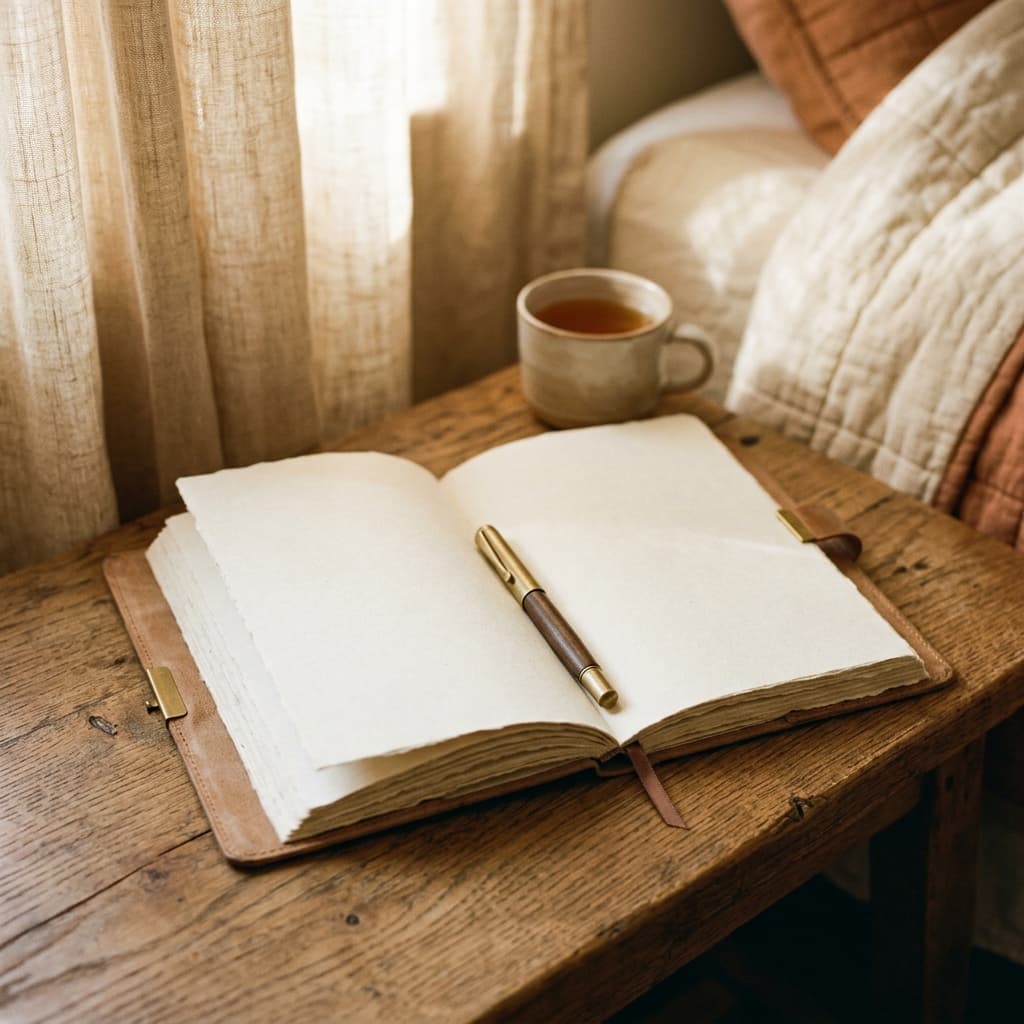
A journal does not solve anything. It listens. And sometimes, being heard by your own handwriting is enough.

We suppress anger because we were taught it is dangerous. But anger is a signal, and silencing it means missing what it has to say.
Things people often wonder about this space.
More ways to engage with this practice.
If something here reached you at the right moment, I am glad you found it. This space is not going anywhere. It will be here whenever you need to come back, as quiet and steady as the practice it was built from.