The first time I wrote something that mattered, I was sitting in a parking garage at work with the engine off and my hands shaking. Not shaking from cold or caffeine. Shaking the way hands shake when the body has been carrying something the mind refuses to name, and the weight has finally exceeded what the muscles can hold. I had been sitting there for eleven minutes. I knew it was eleven because the dashboard clock said 8:07 when I turned the car off and 8:18 when I picked up the pen, a ballpoint from the center console, the kind that writes on receipts and napkins and the backs of old meeting agendas. I did not have a notebook. I had the back of a parking validation ticket. And I wrote three words on it that I will not repeat here, far from profound or beautiful. They were just honest, in a way I had not been honest with myself in months, and the honesty made my hands shake harder, and then, after a few seconds, made them stop.
That was four years ago. I still have the parking ticket. I cannot read the words anymore because the ink has faded to a gray smear, but I do not need to read them. My hands remember the pressure of the pen against the cardboard, the way the ballpoint caught on the rough surface, the specific resistance that slowed the writing to a speed my body could follow. That resistance is where everything began.
What the Hand Knows That the Mind Does Not
There is a difference between typing and writing by hand that goes beyond preference or nostalgia. When I type, my fingers move at the speed of thought, sometimes faster, and the words appear on screen with a clean precision that makes them look finished before they are true. When I write by hand, the speed drops to the pace of formation. Each letter is drawn. Each word costs something in time and physical effort. And in that slowness, something changes: the mind stops narrating and starts listening, because the hand has taken over, and the hand does not know how to lie.
I notice this in my own handwriting. When I am being careful, performing insight, writing what I think I should feel, the letters are even and the lines are straight. When I am being honest, the handwriting changes. It slants. It speeds up in places where the truth is coming fast and slows down in places where the truth is heavy. The pressure varies: lighter when I am uncertain, heavier when I am angry, so heavy sometimes that the pen embosses the next three pages. More than a container for my thoughts, the notebook is a seismograph for my body, recording tremors I did not know I was having.
James Pennebaker, the psychologist who spent decades studying what he called expressive writing, found that people who wrote about emotionally significant experiences for fifteen to twenty minutes a day showed measurable improvements in immune function, mood, and even the speed of wound healing. The mechanism, he proposed, is that writing creates a coherent narrative from fragmented emotional experience. The act of putting words on a page organizes what is chaotic, and in that organization, the body finds relief.
I believe Pennebaker is right, but I think the relief starts before the narrative coheres. It starts in the hand. It starts in the physical act of slowing down, of making the body do something deliberate and sequential while the mind is still in fragments. The hand imposes order not through meaning but through motion: one letter, then the next, then the next. The body does not need to understand what it is writing. It needs to write.
The Morning Practice
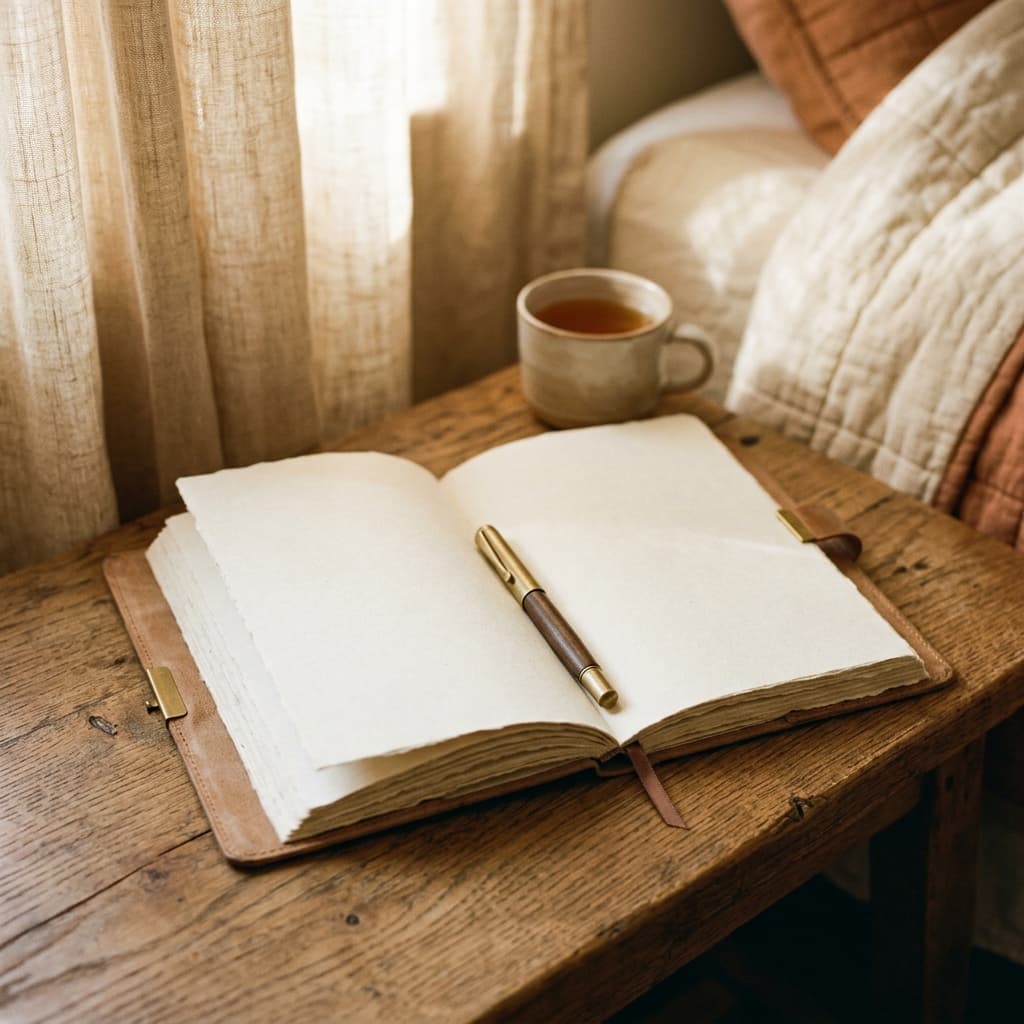
Every morning now, before the day begins telling me what to think, I sit at my desk with the notebook open. The tea is too hot to drink. The light through the window is gray and soft, the particular quality of early morning in the Pacific Northwest where the sky has not yet decided whether it will commit to the day. My pothos plant casts a faint shadow across the page when the light comes through at the right angle, a pattern of leaf-shapes that moves as the morning brightens, and sometimes I write around the shadows, filling the spaces they leave, as if the plant is collaborating.
I write whatever arrives. I do not plan. I do not edit. I do not care whether it is interesting or insightful or worthy of the cream-colored pages. Most of what I write is not. Some entries are lists of what I need to do. Some are complaints so petty I would be embarrassed to say them aloud: the neighbor’s leaf blower at seven in the morning, the way someone chewed during a phone call, the small indignities that accumulate in a life and have nowhere to go except the page. Some entries are three sentences. Some fill four pages and leave me late for the rest of the morning.
The quality does not matter. I need to say that again, because it is the hardest part to believe: the quality does not matter. What matters is the regularity, the daily act of sitting down and letting the hand move, which is another way of saying the daily act of asking the body what it knows and giving it a surface to answer on.
What the Page Receives
I journal to be heard. Not by anyone else. By myself. The page does not judge, interrupt, suggest a solution, or tell me that what I am feeling is disproportionate. It receives. When I write “I am tired in a way sleep does not fix,” the page does not prescribe a supplement or recommend better sleep hygiene. It holds the sentence. It lets it exist in my own handwriting, in the specific pressure and slant that my hand chose for those words, and sometimes that is all a feeling needs: not a fix, but a witness.
I have noticed that the thoughts I am most reluctant to write are the ones that need writing most. The petty jealousies I am ashamed of carrying. The resentments I have told myself I have forgiven but clearly have not, because the pen presses harder when I write about them, and the ink goes thick and dark in the places where the anger is still alive. The fears that sound absurd when spoken aloud but sit in my chest like a stone I cannot dissolve: that I am behind, that the window for the life I wanted has already closed, that I am repeating patterns I swore I would break.
On the page, they lose their absurdity and their shame. They are just true. And truth, even the uncomfortable kind, feels lighter once it has been written in your own hand. Not because the writing solves anything. It does not. But because the act of writing moves the feeling from the chest to the page, from the place where it was compressing my breathing to a surface where it can exist outside of me, still mine, still real, but no longer locked inside the only body that was carrying it.
The Hands That Shred the Corners
My notebooks have a habit of coming apart. Not from overuse exactly, but from what my hands do to them when I am thinking. I shred the corners. I did not know this about myself until a friend pointed it out during a meeting, years ago, when she looked at my notebook and said, “What happened to your pages?” I looked down and saw that I had reduced the bottom corner of the current page to a soft pile of paper confetti, and I had no memory of doing it.
I still do it. My left thumb works the corner of the page while I am reading back what I wrote, rolling the paper between my thumb and forefinger in a small, rhythmic motion that I cannot seem to stop and have stopped trying to. The notebooks in my drawer all have the same damage: pristine at the top, tattered at the bottom right corner, a record of every moment my hands needed to be busy while my mind was processing something it could not yet say.
I used to think this was a flaw. Now I think it is part of the practice. The hands do not just write. They fidget, they press, they tear, they grip the pen until the knuckles whiten during the sentences that cost the most. The notebook receives all of it: not just the words, but the physical evidence of what the words cost. That is what I mean when I say the page listens. It listens with its whole surface, not just the part where the ink lands.
A journal is not a record. It is a practice. The page listens, and then it lets go. That is the whole ritual, and it is enough.
I do not reread my journals. I used to think that was the point, that someday I would open the stack of notebooks in my desk drawer and trace the arc of my own growth, find the patterns, see how far I had come. I do not do this. The value was never in the reading. It was in the writing: the morning act of sitting down, picking up the pen, and letting the hand say what the mouth has not found words for yet. The page does not need me to come back. It already did its work the moment the ink dried.
The parking garage was four years ago. The shaking hands, the ballpoint, the back of a validation ticket. I think about it sometimes when I sit down with the notebook in the morning, in the soft gray light, with the tea too hot and the pothos casting its leaf-shadows across the page. The practice now is quieter than it was then. The hands are steadier. The words come more easily, or at least they come without the trembling that accompanied them in the beginning. But the essential act is the same: the hand moves, the page receives, and something in the body, something that was compressed and nameless, finds its way onto a surface where it can finally be still.
If you are curious, try this: set a timer for five minutes and write whatever arrives, by hand, on any surface you have. It does not need to be a beautiful notebook. A napkin will do. A parking ticket will do. Do not stop to think. Do not cross anything out. Let the pen move and let whatever comes be enough. If the words surprise you, that is the practice working. If your handwriting changes, press harder in places, slants in directions you did not choose, pay attention to that. The hand is telling you something the mind has not caught up to yet. And if nothing comes, let the pen rest. Some practices take time to take root. The page is patient. It will be there tomorrow.
