The desk was covered. Three half-empty mugs, a tangle of charging cables, sticky notes layered so deep the bottom ones had curled at the edges, and a stack of papers I had been meaning to file since the previous month. I sat down one Tuesday morning, opened my laptop, and realized I could not think. Not because the work was difficult, but because every object on that surface was asking something of me. Each unfinished item was a small, open loop, and my attention was trying to hold them all at once.
That was the morning I cleared the desk.
The Visual Weight of Clutter
What I did not understand then, and what took me years to learn, is that the problem was perceptual rather than a matter of willpower. Researchers Sabine Kastner and Ryan McMains at Princeton’s Neuroscience Institute found that multiple visual stimuli compete for neural representation in the visual cortex. When your field of view contains many objects, your brain allocates processing resources to each one, whether you are consciously attending to it or not. The cluttered desk was doing more than distracting me. It was consuming cognitive resources before I had even opened a document.
This explains why a clean surface feels different the moment you sit down. The absence of competition. Your visual cortex has fewer signals fighting for bandwidth, and the result is a wider window of attention available for the task in front of you.
What Stays on the Surface
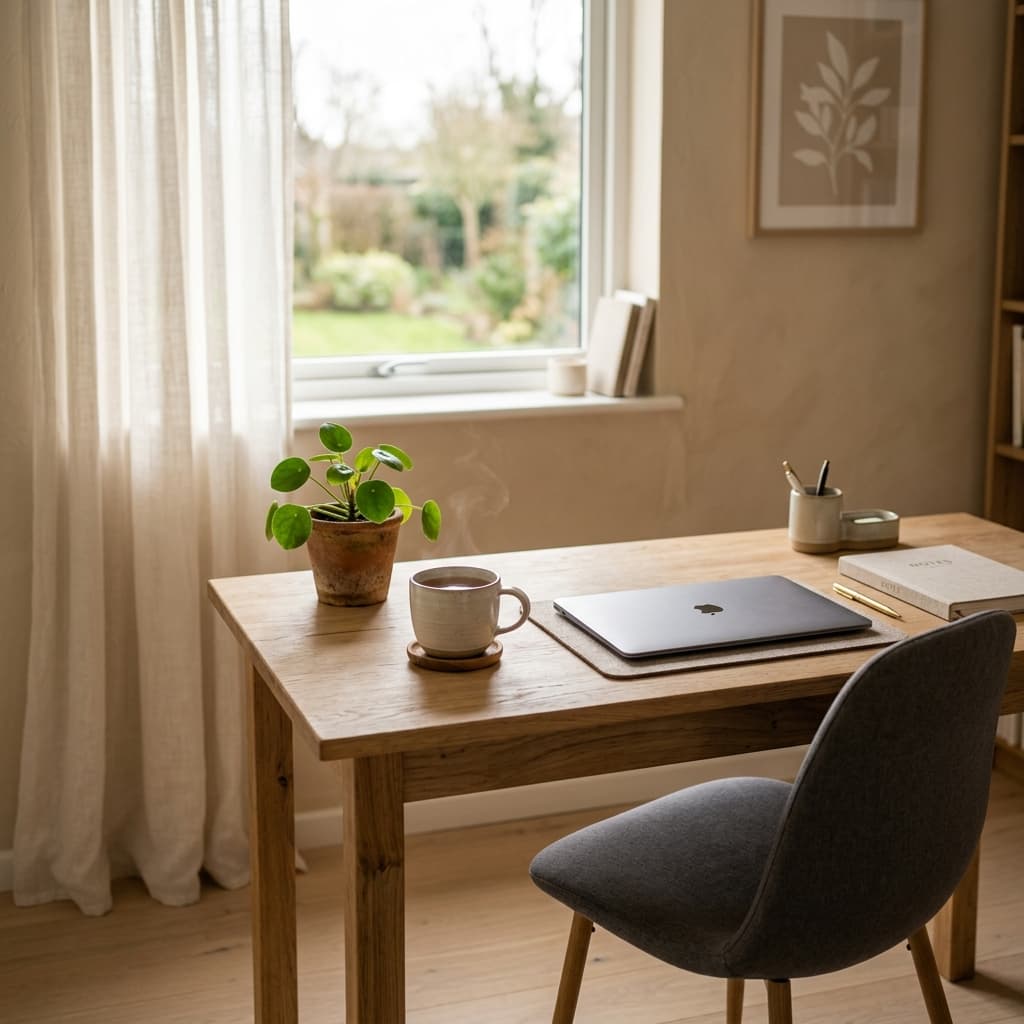
I start each workday now with a small ritual of selection. I look at the desk and ask: what do I need for the next two hours? The notebook. A single pen. The laptop. A cup of tea, the ceramic one with the chip on the rim that fits my hand in a way no other mug does. Everything else goes into a drawer or onto a shelf. Not thrown away. Just moved out of my visual field.
I have also learned to bring something living to the surface. A small pothos in a terracotta pot sits at the corner of my desk. I can see the glossy green of its leaves in my peripheral vision, and on mornings when the light comes through the window at the right angle, it casts a faint shadow across my notebook. Researchers Rachel and Stephen Kaplan developed Attention Restoration Theory, which suggests that natural elements restore directed attention by engaging the mind in a way that requires no effort. The plant functions as a micro-recovery station, pulling my attention gently back from wherever it has drifted.
A clear desk is not minimalism for its own sake. It is a decision about what deserves your attention and a boundary against everything that does not.
The Mental Workspace
A mindful physical workspace is only half the practice. The digital workspace needs the same curation. I close every browser tab except the one I am working in. I keep my email client shut until a designated time. My phone sits face down in another room, not because I distrust myself, but because the mere presence of a phone, even silenced, has been shown to reduce available cognitive capacity. A study by Adrian Ward and colleagues at the University of Texas found that having a smartphone within reach, even powered off, occupies a portion of working memory. The phone does not need to ring to cost you something.
I practice single-tasking. One document. One train of thought. One thread at a time. When I notice the urge to check something, I write the impulse on a scrap of paper and return to it later. The paper catches the thought so my mind does not have to hold it. This small act of externalization frees the working memory that the impulse was quietly occupying.
The Closing Ritual
The end of the workday matters as much as the beginning. Without a clear ending, work bleeds into evening, and the residue of unfinished tasks follows you to the dinner table, the couch, the pillow. I have built a small closing ritual that takes less than five minutes. I wash my tea mug, feeling the warm water run over my fingers. I file or recycle the day’s papers. I write three priorities for the next morning on a single index card and leave it centered on the clean desk.
Then I close the laptop. Not sleep mode. Close. The click of the lid is a boundary. It says: the work is finished, even if the work is not done. This distinction matters. The work is never truly done. But the workday can be, and declaring that boundary is an act of kindness toward the person you become in the evening.
If you are willing, try this tomorrow morning: before you open your laptop, take sixty seconds to clear your desk down to only what you need for the first task. Move the rest out of sight. Notice what it feels like to sit down to a surface that is not asking anything of you. If it helps, do it again the next day. If it does not change anything, let it go. The practice is the noticing that the clearing makes room for.
