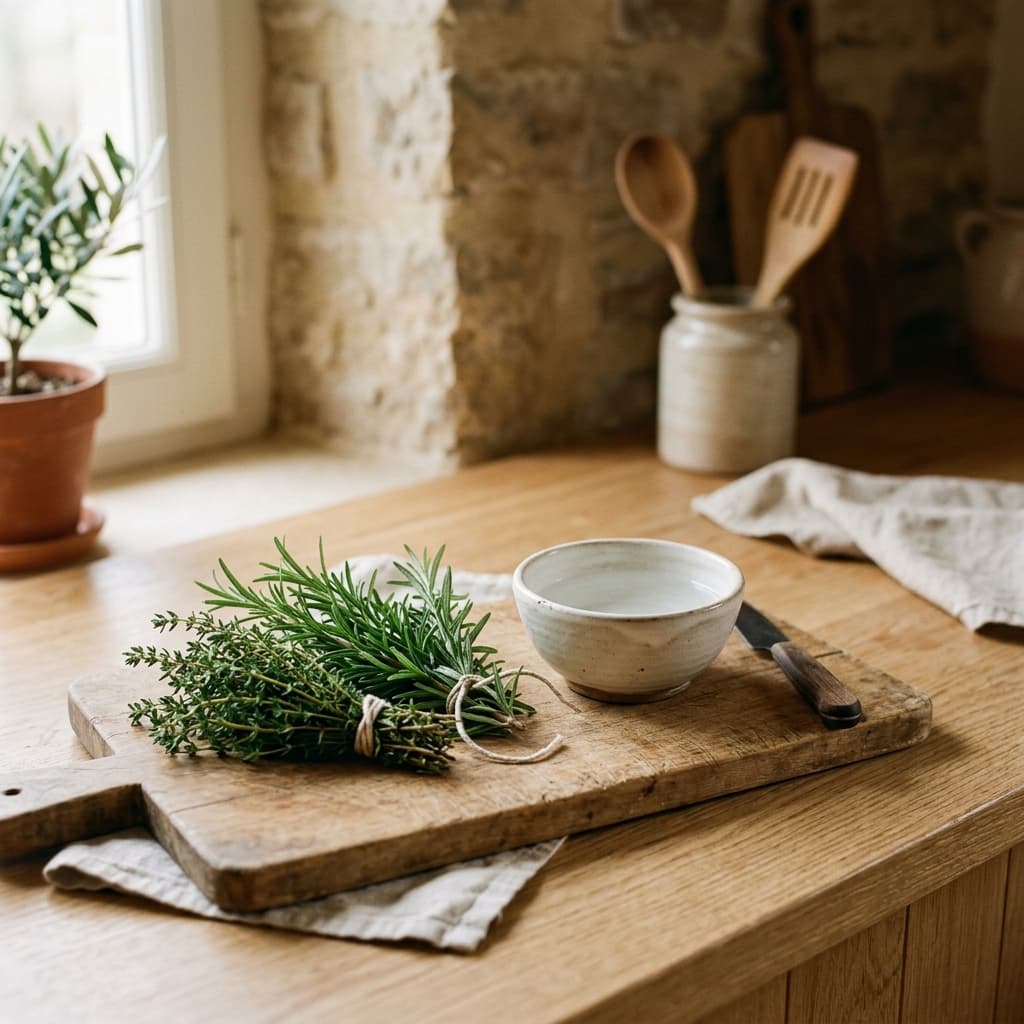
A yellow onion on the cutting board, the one with the groove worn into its center from years of the same knife in the same hand. Late-afternoon light coming through the kitchen window at the angle it only reaches in November, turning the countertop the color of weak tea. I was chopping fast, head down, the knife hitting the board in quick, impatient strokes. The garlic went in without being smelled. The oil hit the pan without being watched. I was making food, but I was not in the kitchen. I was already at the table, already finished, already somewhere else.
Then I noticed I had been holding my breath. Not from effort. From speed. And something, I do not remember what, made me slow down.
The Kitchen as Sensory Practice
Cooking is one of the few daily activities that naturally engages all five senses at once. The sound of the knife against the board. The sharp, eye-watering scent of garlic as it releases its oils. The cold, smooth skin of a cucumber under your fingers. The hiss of vegetables hitting a hot pan. The color of carrots turning from raw orange to a deeper, caramelized amber. No other routine task offers this density of sensory input, and yet we rush through it as though the point were the product rather than the process.
Jon Kabat-Zinn, the molecular biologist who developed Mindfulness-Based Stress Reduction, often uses eating as an entry point for mindfulness practice. His raisin exercise, in which a single raisin is examined, smelled, and eaten over several minutes, demonstrates how much sensory information we discard when we consume without attention. The kitchen extends this principle. When you chop an onion with full attention, you are practicing active presence, and the practice is available every time you pick up a knife.
Preparation as Transition
Cooking slowly also serves a physiological purpose. The time spent preparing food is a transition from the sympathetic activity of the day, work mode, decision mode, output mode, into the parasympathetic receptivity that digestion requires. When you smell food as it cooks, your body begins producing digestive enzymes before the first bite. The salivary glands activate, the stomach begins its quiet preparation, and the entire digestive tract shifts from dormancy to readiness. When you sit down to a meal you have prepared with attention, your nervous system is already primed to receive it.
The reverse is also true. Eating food you did not prepare, in front of a screen, while half-reading an article, is a sensory experience so thin it barely registers. The body eats, but the mind was never at the table. Something important goes missing: a kind of presence that no delivery app can provide.
When we prepare food with care, we are practicing an ancient form of attention. We are telling ourselves, and anyone we feed, that nourishment is worth our time.
A Simple Kitchen Ritual
You do not need to cook elaborate meals to practice this. A simple bowl of soup, a plate of roasted vegetables, even a piece of toast made with full attention can become the ritual. The key is engagement, not complexity. Here is the sequence I follow on evenings when I want the kitchen to be a practice rather than a production line:
- Put the phone in another room. Let the kitchen sounds be the only soundtrack.
- Before you begin, take one breath. Feel the weight of the knife or the spoon in your hand.
- Notice the colors of the raw ingredients before you change them with heat.
- Listen to the sounds of cooking: the sizzle, the bubble, the quiet moments in between.
- Eat without a screen. Let the meal be the only event.
It does not have to be every meal. It does not have to be every day. Even once a week is enough to remind your body what it feels like to be present for the act of feeding yourself.
The Same Kitchen, Later
Tonight, the yellow onion is on the same cutting board, in the same groove. The November light has shifted to December, a little lower, a little earlier. The knife is in my hand. I am chopping, but I am not racing. The first cut releases the onion’s sharp, sulfurous breath and my eyes sting and I let them. The garlic goes in and I smell it this time, that warm, pungent heat that says something is about to become food. The oil hits the pan and I watch it shimmer, watch the tiny currents form on its surface as it heats.
The kitchen has not changed. The cutting board is the same board. The knife is the same knife. But I am in the room now. My feet are on the tile floor and I can feel the cold through my socks. My breath is slow and it matches the pace of the cooking, the food’s time, not mine. Something has shifted. The kitchen is the same. I am the one who is different.
This week, if you are willing, choose one meal to cook with your full attention. It can be the simplest thing you know how to make. The practice is about being in the kitchen, truly in it, for the time it takes. Notice how the food tastes when your body was there for its entire arrival. If the experiment feeds something beyond your stomach, try it again. If it does not, that is fine too. Some rituals need to be found, not forced.
