We live in artificial constancy. The same temperature in every room. The same light at every hour, courtesy of screens and overhead fixtures. The same pace expected of us in January as in July. Modern life has severed us from the rhythms that governed human existence for millennia, and we pretend not to notice.
But our bodies notice. I notice it in my hands first: the stiffness in the knuckles that arrives in October and does not fully leave until April, a tightening in the joints that no amount of central heating can reach. I notice it in my appetite, which deepens in autumn in ways the summer version of me would not recognize, a craving for warmth and density, for soups and stews and the particular comfort of food that takes hours to cook. I notice it in the weight of my eyelids at four in the afternoon on a December day, a heaviness that is not laziness but biology, the body responding to a darkness the thermostat cannot override.
Till Roenneberg, a chronobiologist at Ludwig Maximilian University of Munich, has spent decades studying how light exposure governs the body’s internal clock. His research shows that seasonal changes in daylight length alter melatonin production, cortisol rhythms, and even cognitive processing speed. We are not the same organism in February as we are in July. The body adjusts its chemistry with the turning of the earth, and when we refuse to adjust our expectations accordingly, the mismatch produces a fatigue that sleep alone cannot address.
Winter: The Permission to Rest
Winter asks us to slow down, and we refuse. We schedule just as many meetings. We exercise with the same intensity. We expect the same energy from ourselves at five o’clock darkness as at nine o’clock light. And then we call ourselves lazy when we cannot keep up.
I know winter in my body as a heaviness in the legs, a reluctance in the muscles that shows up before the alarm goes off. The bed is warmer than the air, and the distance between the duvet and the floor feels, on a January morning, like a crossing that requires genuine courage. Far from weakness, this is the body doing what every mammalian body has done for millions of years: conserving energy when the light is short and the cold is real.
What if winter is not a season to push through but a season to lean into? The natural world goes dormant. Seeds rest. Trees pull their energy inward. Nothing is growing, and nothing is supposed to be.
Spring: Beginning Gently
Spring is not an explosion. It is a slow unfolding. The first green is tentative, fragile, easily overlooked. And yet we treat spring like a starting gun, another burst of ambition and overcommitment.
But look at how spring actually works. It does not arrive all at once. It sends signals. A warmer afternoon on the back of the neck. The smell of wet earth after a rain, a mineral sweetness that the frozen ground withheld for months. The particular restlessness in the legs that arrives in March, an urge to walk that is not about exercise but about the body responding to longer light, to the promise of warmth that the skin can feel before the thermometer confirms it.
Spring teaches patience. It teaches you to begin before you are ready, but gently. Not with force. With curiosity.
When you live in tune with the seasons, you stop fighting your own nature. You stop expecting constant summer. And in that acceptance, you find a gentler way to move through the year.
Summer: Expansion and Presence
Summer is the season of outward energy. Long days, open windows, the impulse to connect and move and be outside. The body knows summer before the calendar announces it: a loosening in the chest, a lightness in the step, the specific pleasure of warm air on bare arms after months of sleeves and layers.
But even summer has its lesson in balance. The long days are an invitation, not an obligation. You do not have to fill every hour of light. Some of the best summer moments are the ones where nothing happens at all. An afternoon on the grass, feeling the blades prick the backs of your calves. The sound of evening through an open window. Presence, not productivity.
Autumn: The Practice of Release
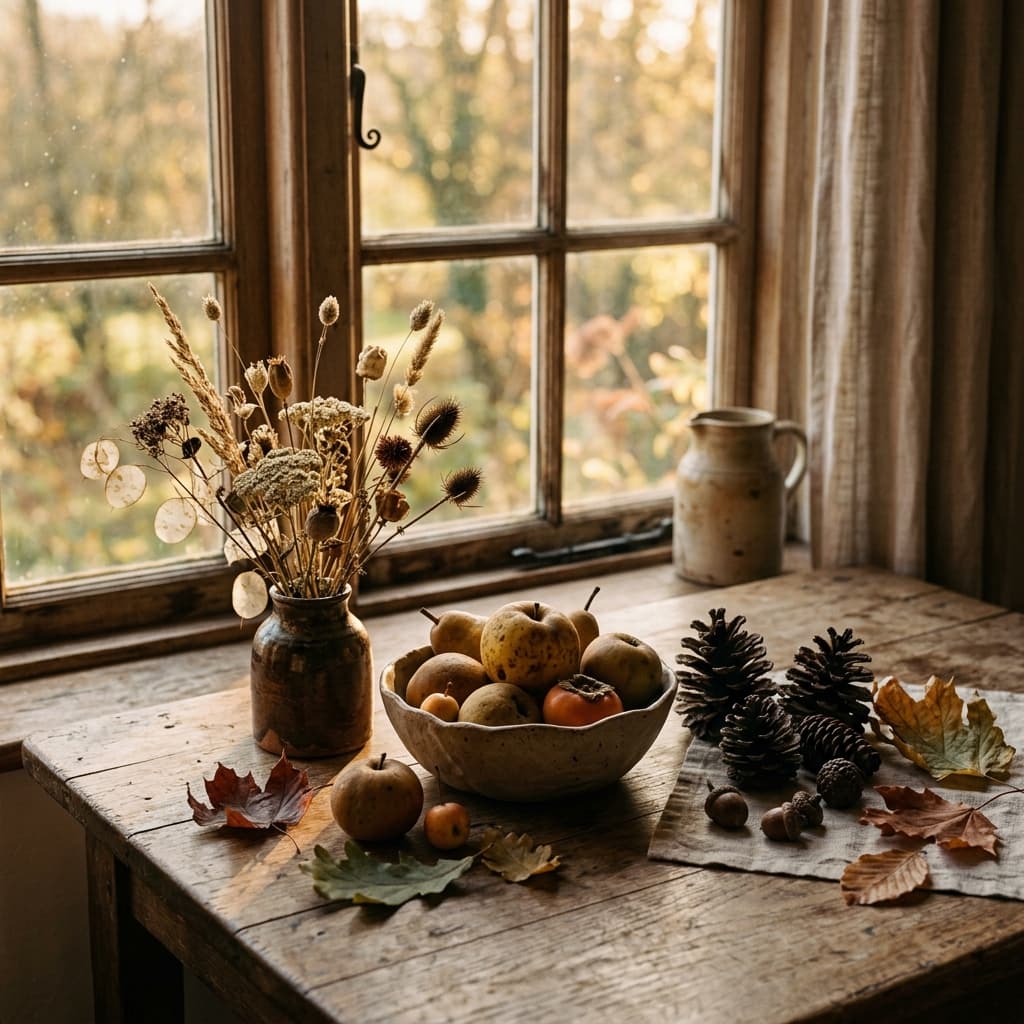
Autumn is the most instructive season for the practice of letting go. Watch the trees. They do not cling to their leaves. They do not grieve what is falling. They release. And in that release, they prepare for what comes next.
I feel autumn in my shoulders. A dropping, a settling, as if the body itself is exhaling after the long inhalation of summer. The air sharpens. The light changes angle, arriving at the window lower and more golden, casting longer shadows across the kitchen floor in the afternoon. The skin on my forearms prickles at the first cool evening, and the prickling settles into something almost welcome—the body registering the turn, acknowledging that something is ending and making room for what comes next.
Seasonal living is not a system. There are no rules. It is simply the practice of paying attention to the world outside your window and asking: what is this season inviting me to do? If you are willing, try this: the next time you feel tired and cannot explain why, look out the window. Notice the light. Notice the temperature. Notice whether the day is short or long, and whether your energy matches the season rather than the schedule. You may find that your body has been answering a question you forgot to ask. If the answer does not come today, let it go. Some seasons reveal their lessons slowly, and that is part of what they teach.
