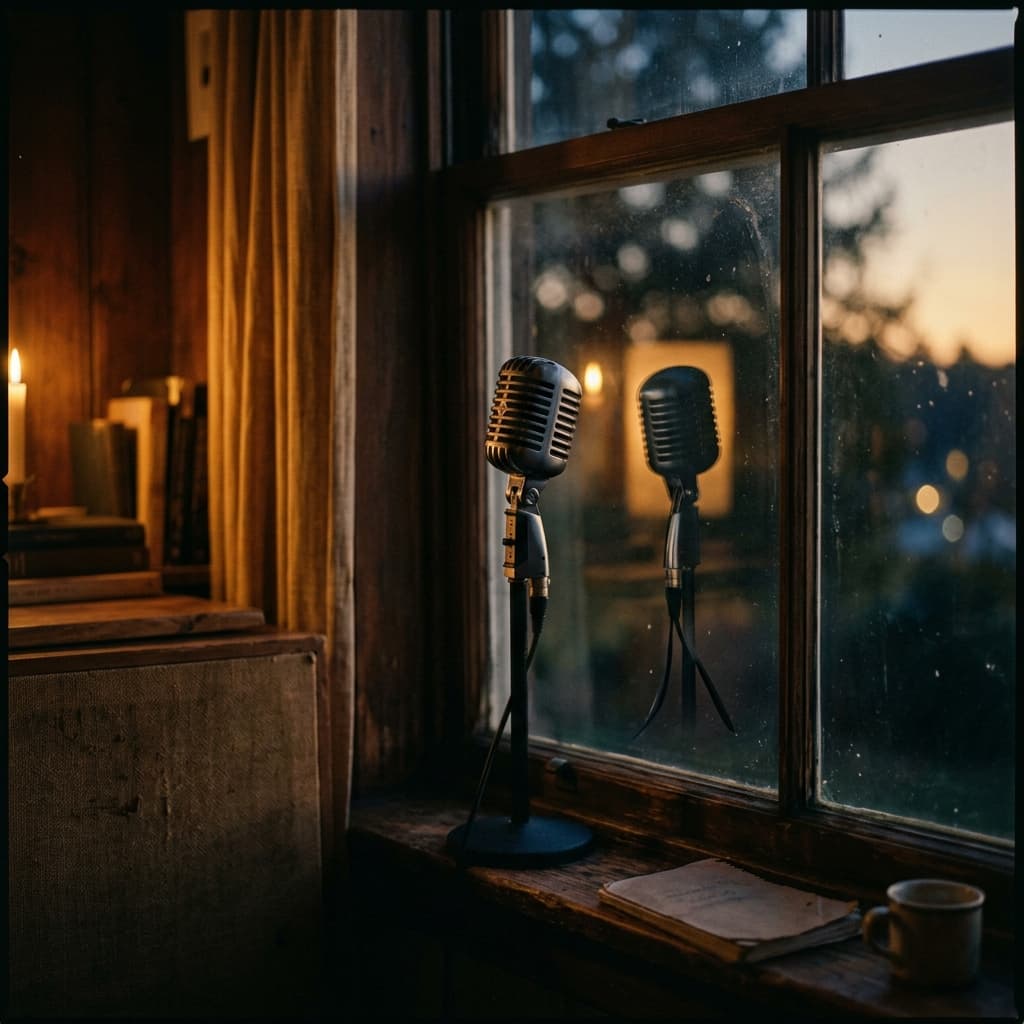
The recording was from a work presentation, three years ago, sent to me by a colleague who thought I might want it for reference. I did not want it for reference. I did not want it at all. But I played it on my laptop in the kitchen after my daughter was asleep, and the voice that came through the speakers was a stranger’s: higher than I expected, thinner, with a careful precision in the consonants that sounded like someone who had rehearsed not just the words but the way the words should land. The vowels were measured. The pauses were strategic. The laugh, when it came, was the short, professional laugh I recognized as the one I deploy to put a room at ease, not because anything is funny but because the silence after a sentence feels too exposed.
I stopped the recording at four minutes and twenty seconds. Not because the content was bad. Because the voice made my chest tight, and the tightness, which I first mistook for embarrassment, turned out to be recognition. I was listening to a performance so practiced that it had become invisible to me, a version of my voice so thoroughly constructed that I had mistaken the construction for the original. And somewhere beneath the constructed voice, the one with the careful consonants and the strategic pauses, was another voice, and I could not remember the last time I had heard it.
The Two Gaps
There is a well-documented acoustic gap between the voice you hear in your own head and the voice others hear. Researchers call it voice confrontation: the internal voice benefits from bone conduction, resonating through the skull’s dense tissue, which amplifies lower frequencies and creates a richer, deeper sound. The external voice travels through air, arrives thinner, higher, stripped of the bass frequencies that bone conduction provides. The voice you know best is the one no one else has ever heard.
But there is a second gap, and this one is performative rather than acoustic. Erving Goffman, the sociologist, described social life as a series of performances, each tailored to a specific audience. We use one voice with authority figures, another with friends, another with strangers, another with the person behind the counter at the post office. We pitch our laughter differently in meetings than we do at home. We modulate our confidence, our vulnerability, our humor, adjusting the volume of each to match what we believe the room requires.
Goffman’s framework is brilliant, but I think he underestimates the cost. He describes performance as a neutral social mechanism, the way we manage impressions to facilitate interaction. What he does not fully account for is what happens when the performance runs for years without interruption. When you modulate your voice for so long that the modulated version becomes the default, and the original frequency, the one you were born speaking in, gets buried under so many layers of adjustment that you can no longer tell where the performance ends and you begin.
That is what the recording showed me. Not a person being fake. A person who had been performing so long she could no longer hear the difference.
Where the Real Voice Lives
I started listening for it. Not the constructed voice, not the bone-conduction voice, but the third one: the voice that surfaces when there is no audience, no impression to manage, no room to read. I found it in unexpected places.
The low, tuneless humming while waiting for the kettle to boil, a sound so unconscious that I did not know I was making it until my daughter imitated it one morning, perfectly, and I heard my own frequency played back to me by a nine-year-old standing on her toes to reach the sugar bowl. The particular tone I use when I talk to myself while looking for something I have misplaced, a tone that is neither patient nor impatient but somewhere between, a private negotiation conducted in a register no one else has ever heard.
The laugh that escapes before I can shape it, the real one, which is louder than the professional laugh and shorter and ends with a small snort I have spent years suppressing in public. The voice that comes out when I am reading aloud to my daughter at bedtime, which drops half a register into a warmth I do not deploy anywhere else, a warmth that is not performed because the audience does not require performance, just presence, and the absence of requirement is what allows the real frequency to surface.
These sounds are far from polished, and they are not the voice I would choose if I were designing myself from scratch. But they carry a texture that the constructed voice does not have, a quality I can only describe as weight: the sound of a voice released from the effort of landing anywhere in particular, just being spoken, the way breath is just breathed, without intention or optimization or concern about how it sounds from the outside.
The Body of the Voice
Voice is a physical event as much as a sound. The diaphragm drops. The intercostal muscles expand the ribs. The air travels upward through the trachea, vibrates the vocal folds at a frequency determined by their mass and tension, and then passes through the throat, mouth, and nasal passages, where the resonant cavities of the skull shape it into something recognizable. Every spoken word is a full-body act, and the body’s state determines the voice’s quality in ways that are difficult to fake.
When I am anxious, my voice lives in my throat. The sound is tight, the pitch is higher, the words come faster because the body wants to finish speaking and return to the safety of silence. When I am tired, the voice drops. It slows. The words come out with less precision, and the imprecision makes them somehow more honest, as if exhaustion strips away the editing function and lets the raw material through.
When I am genuinely present, the voice comes from a different place entirely. Lower in the body, anchored somewhere around the diaphragm, with a steadiness that is not confidence, not exactly, but something closer to groundedness: the sound of a voice that knows where it is standing. I cannot manufacture this voice. I can only notice when it arrives, and try not to interfere with it when it does.
What I Have Not Figured Out
I still perform. I still modulate. I still deploy the professional laugh and the careful consonants and the measured pauses in rooms where the stakes feel high enough to warrant the construction. I do not know whether it is possible to fully stop performing, or whether the performance, in some contexts, is a necessary form of social lubrication that allows difficult conversations to happen without friction becoming damage.
What I am trying to do is narrower than authenticity. I am not trying to be the same person in every room. I am trying to notice when I am modulating, and to ask whether the modulation is a choice or a reflex. When I raise my pitch to seem more agreeable, is that a decision I am making, or a pattern that runs automatically, installed so early that it feels like me rather than something I learned? When I add qualifiers, “I think,” “maybe,” “I could be wrong,” to soften a statement I am certain of, is that generosity or fear?
I do not have answers. I have the sound of my own humming when I think no one is listening, and the bedtime voice that drops into warmth, and the laugh I cannot control, and the growing suspicion that those unpolished sounds are closer to who I am than anything I have ever said into a microphone. Whether that suspicion leads somewhere, I do not know yet. The voice is still searching for its own frequency, and the search, for now, is the practice.
Your real voice is not the loudest one. It is the one that appears when you stop performing for the room, and it sounds, the first time you hear it, like a stranger who has been living in your house all along.
If you are curious, try this: record yourself talking about something you genuinely care about, without preparing what you will say. Play it back. Listen not for flaws but for moments of realness, the places where the voice warms, loosens, drops into a register you did not plan. Those moments are the signal breaking through. If the exercise feels too exposing, let it go. Instead, notice your voice the next time you are alone: humming in the kitchen, talking to yourself while you look for your keys, reading aloud to no one. That unperformed sound is worth more than any presentation voice you have ever perfected. It is the voice that belongs to no audience, and it has been there all along, waiting for the room to empty.
